

Low stock: 1 left
Martial Solal – At Newport ’63
Martial Solal – At Newport ’63
Couldn't load pickup availability
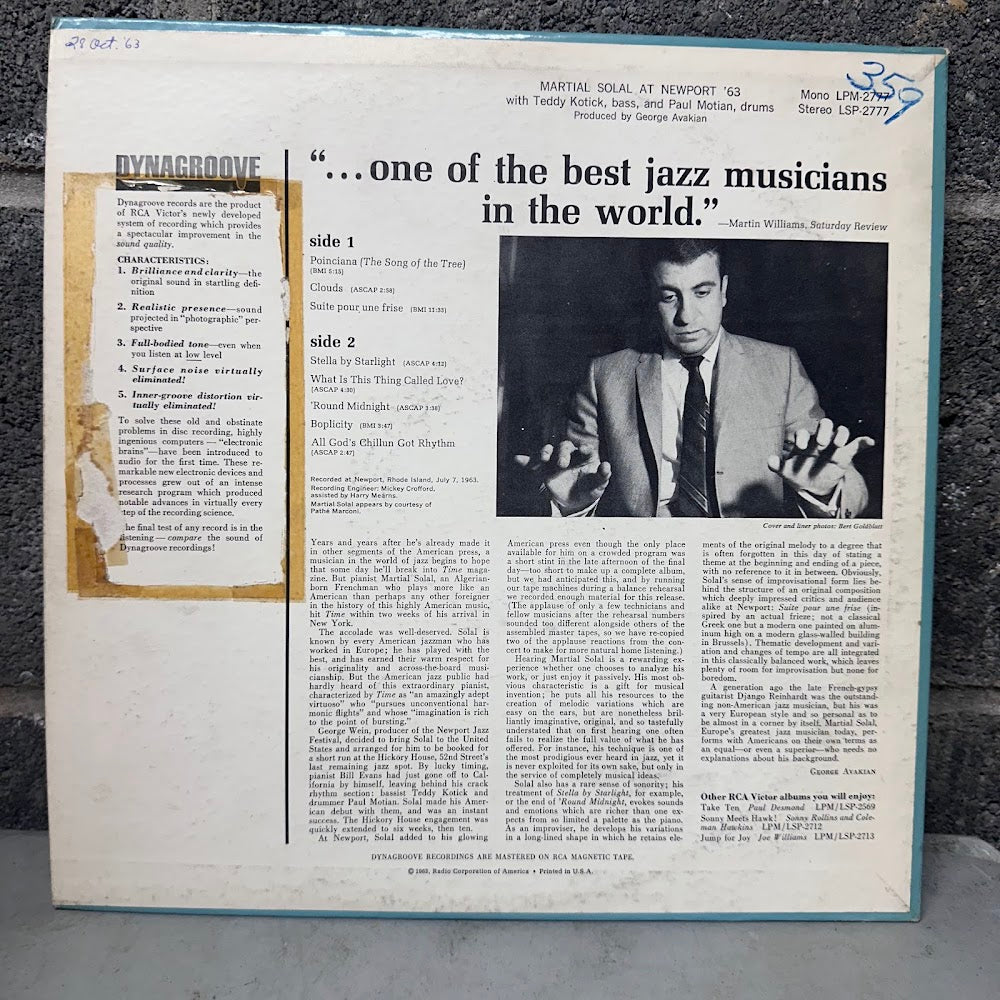
A superb early American showcase for French jazz pianist Martial Solal, At Newport ’63 captures one of Europe’s most distinctive modern-jazz voices at the moment he was being introduced to a wider American audience. Released by RCA Victor in 1963, the album pairs Solal with an exceptional rhythm section: Teddy Kotick on bass and Paul Motian on drums, with production by noted jazz producer George Avakian. Contemporary listings confirm RCA issued the album in both mono (LPM-2777) and stereo (LSP-2777); this is the stereo LSP-2777 edition.
Solal's playing combines remarkable technical command with the harmonic sophistication and rhythmic invention of modern jazz. The program moves comfortably between standards and more adventurous material, including “Stella by Starlight,” “‘Round Midnight,” “What Is This Thing Called Love?,” “Boplicity,” “Poinciana,” “Clouds,” “All God’s Chillun Got Rhythm,” and Solal's extended composition “Suite pour une frise.” The combination of Solal, Kotick and Motian makes this an especially interesting piano-trio recording, with the rhythm section giving Solal plenty of room for his unpredictable phrasing and improvisational turns.
The album also occupies an interesting place in Solal's career. His reputation was already well established in European jazz circles, but 1963 marked an important American breakthrough. The striking turquoise RCA Victor sleeve announces him as “Europe's Greatest Jazz Pianist” and bills the LP as his “First American Recording!” The jacket also carries endorsements from Duke Ellington and Dizzy Gillespie—a fascinating snapshot of how RCA introduced Solal to American record buyers.
For collectors of modern jazz, European jazz pianists, Paul Motian recordings, and classic RCA Victor releases, At Newport ’63 is an appealing piece of early-1960s jazz history. The LSP-2777 stereo catalog number, RCA Victor Dynagroove branding, period artwork and 1963 copyright shown on this copy are consistent with the album's original-release era. Contemporary sources also list the stereo LSP-2777 release in 1963.
Share